Tynan918
Active Member
- Messages
- 309
- Location
- United States
What are my chances of cracking or breaking the acrylic by drilling it on my own ?It's fairly easy with a steady hand, just measure/mark them all beforehand and you're golden.
What are my chances of cracking or breaking the acrylic by drilling it on my own ?It's fairly easy with a steady hand, just measure/mark them all beforehand and you're golden.
Looks good. Just get a good drill bit, take your time and you will be fine. Once you see how easy it can be you will want to make all your own enclosures.Alright, I have the money to pay for a custom cut acrylic enclosure lid from TAPS...View attachment 75784
I'm going to go 1/4" thick...(4 pennies)View attachment 75788
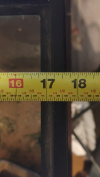
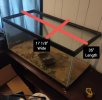
35" in length...View attachment 75785
And 17 1/8" wide...View attachment 75787
That will work. Yeah to drill glass is a little more expensive and time consuming. It would be easier just to make an enclosure out of acrylic.I'm told in a Facebook group that 1/8" holes is the size I should drill the ventilation holes in the acrylic lid for this medium to large adult female T. Blondi I'm going to buy...sound about right ?
I can't drill the sides of the enclosure as it's real glass.
I don't have any more money to invest to buy more acrylic plus everything else said to be needed, I'm just going to drill in enough holes in the lid.That will work. Yeah to drill glass is a little more expensive and time consuming. It would be easier just to make an enclosure out of acrylic.
I’ve never used charcoal in any of my bioactive enclosures. That being said my current enclosure is my first bioactive t enclosure(I’ve always kept snakes up until now). Most people, myself included, use clay balls made for aquaponics or lava rock as a drainage layer. I wouldn’t use Isopods as they can stress the T out, some people say there are certain ones that work but I can’t speak on that. You could use wood from outside but it requires cleaning and heating in an oven. As for what decor is best for T. Blondi someone else will have to answer that as I’ve never kept one.Another question regarding the supplies to create the "natural bioactive terrarium"...
Here are the items I wrote down during research :
1. Charcoal
2. Vermiculite
3. Soil
4. Reverse Osmosis Water
5. Spackman Peat Moss
6. Coconut Fiber
7. Cork Bark
8. Springtails
9. Dwarf White Isopods
...I read that charcoal really isn't a necessity :
View attachment 75790
View attachment 75791
Should I apply charcoal to this enclosure ?
I assume I can't just break down some grilling charcoal and has to be a specific type of charcoal ?
...And with cork bark, couldn't I just go look for a real wood bark somewhere outside ?
How many pieces of bark do I need for this T. Blondi ? One for the burrow ? They don't explore and need more to adventure with ?
Great information, thank you ! Which of the two drainage layer options is the better option or are the same ?I’ve never used charcoal in any of my bioactive enclosures. That being said my current enclosure is my first bioactive t enclosure(I’ve always kept snakes up until now). Most people, myself included, use clay balls made for aquaponics or lava rock as a drainage layer. I wouldn’t use Isopods as they can stress the T out, some people say there are certain ones that work but I can’t speak on that. You could use wood from outside but it requires cleaning and heating in an oven. As for what decor is best for T. Blondi someone else will have to answer that as I’ve never kept one.
I use small clay balls or if need be I break down bigger ones.Great information, thank you ! Which of the two drainage layer options is the better option or are the same ?
How big is your enclosure and how big of a bag of clay balls do you buy for it ?I use small clay balls or if need be I break down bigger ones.
You will need around 8 to 10 quarts. I buy 10 quart bags from Home Depot for about $22. You can probably find it cheaper on Amazon or chewy.H
How big is your enclosure and how big of a bag of clay balls do you buy for it ?
Trying to figure out how big a bag I need for 40 gallon, 2" depth.

If you rush and are not careful, chances of cracking are high. Slow and steady wins the race.What are my chances of cracking or breaking the acrylic by drilling it on my own ?

Don't think the charcoal brickets with the lighter fluid in them would be good at all ..lol. Natural charcoal would be the thing. No fluid brickets I still wouldn't bother but that's just me. The Biodudes Terra Areanea has charcoal added already but the stuff is expensive. That being said I love the stuff and you can do bioactive with no drainage layer but the few I have set up I still go with the separation mesh and clay balls. But with a tank that size, I'm guessing you would have about 50 dollars of dirt in it. As for your collected from the wild hide I would recommend a trip in the oven on bout 200 degrees or so to eradicate any unwanted guest or mold. Your build sounds extremely fun and best of luck with it. BTW when I enlarge my acrylic enclosures vent holes I use a Dremel tool but with a quarter inch piece of plexi I use standard drill bits starting fine and increasing in size and just trying to go slow. Happy Spoodering!!!!Another question regarding the supplies to create the "natural bioactive terrarium"...
Here are the items I wrote down during research :
1. Charcoal
2. Vermiculite
3. Soil
4. Reverse Osmosis Water
5. Spackman Peat Moss
6. Coconut Fiber
7. Cork Bark
8. Springtails
9. Dwarf White Isopods
...I read that charcoal really isn't a necessity :
View attachment 75790
View attachment 75791
Should I apply charcoal to this enclosure ?
I assume I can't just break down some grilling charcoal and has to be a specific type of charcoal ?
...And with cork bark, couldn't I just go look for a real wood bark somewhere outside ?
How many pieces of bark do I need for this T. Blondi ? One for the burrow ? They don't explore and need more to adventure with ?
All in all, how deep does the mixture of everything need to be for a T. Blondi. ?A 40-gallon tank typically requires between 55 and 110 quarts of substrate for a 2-3 inch layer.
This is based on the general recommendation of 1-2 pounds of substrate per gallon of tank volume.
Since 1 quart is equivalent to approximately 2 pounds, this translates to 2-4 quarts of substrate per gallon.
Here's a breakdown:
1-inch layer: 40 quarts (20 pounds) of substrate.
2-inch layer: 80 quarts (40 pounds) of substrate.
3-inch layer: 120 quarts (60 pounds) of substrate.
FOR A 40-GALLON TANK, THIS MEANS YOU WOULD NEED:
APPROXIMATELY 40-80 QUARTS FOR A 1-2 INCH LAYER.
55-110 QUARTS FOR A 2-3 INCH LAYER.