• Are you a Tarantula hobbyist? If so, we invite you to join our community! Once you join you'll be able to post messages, upload pictures of your pets and enclosures and chat with other Tarantula enthusiasts. Sign up today!

ID assistance

DevinsCreatures

Member
3 Year Member
Messages
36
Location
Nashua, NH
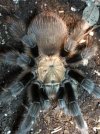
This is definitely an Aphonopelma species, but it’s difficult to say which particular species. Was sold as an Aphonopelma hentzi, which she is definitively not.

Feedback would be greatly appreciated! This girl is very light all over, even her femurs are very light.
EEF11F3F-8BE0-4486-A016-C831D73BC59A.jpeg
 

Attachments

  • FullSizeRender.mov
    72.9 MB

MBullock

Well-Known Member
3 Year Member
Messages
679
Location
Arizona
This is hentzi. Note the extremely dense grizzled setae on the femurs- this feature is not present in anax or armada.

Armada has much shorter setae all over, more velvety looking, same with anax. Anax looks like armada, complete with velvety integument, but is more massively built with really thick legs and a huge cephalothorax
 

DevinsCreatures

Member
3 Year Member
Messages
36
Location
Nashua, NH
This is hentzi. Note the extremely dense grizzled setae on the femurs- this feature is not present in anax or armada.

Armada has much shorter setae all over, more velvety looking, same with anax. Anax looks like armada, complete with velvety integument, but is more massively built with really thick legs and a huge cephalothorax
Thanks for the feedback and I agree with the body layout, but the color is throwing me off. She’s so much lighter than any other Aphonopelma hentzi I’ve seen. Even if she’s premolt, she’s very very light.

This is a picture of my paired mature female Aphonopelma hentzi. This girl has no trace of any of the darkness of A. hentzi.
 

Attachments

  • BA8D5A3A-B2C7-4890-84CB-852FEA3B848A.jpeg
    BA8D5A3A-B2C7-4890-84CB-852FEA3B848A.jpeg
    1.9 MB · Views: 1,635

MBullock

Well-Known Member
3 Year Member
Messages
679
Location
Arizona
Thanks for the feedback and I agree with the body layout, but the color is throwing me off. She’s so much lighter than any other Aphonopelma hentzi I’ve seen. Even if she’s premolt, she’s very very light.

This is a picture of my paired mature female Aphonopelma hentzi. This girl has no trace of any of the darkness of A. hentzi.
Color itself is a poor method of identifying aphonopelma in general unless you have a trained eye and observe them in the wild and figure out all the different morphs and color phases. cephalothorax measurements are a better way to identify them, generally. Especially when it comes to telling iodius and eutylenum apart.
 

Latest posts

Top