• Are you a Tarantula hobbyist? If so, we invite you to join our community! Once you join you'll be able to post messages, upload pictures of your pets and enclosures and chat with other Tarantula enthusiasts. Sign up today!

Care Information for Pamphobeteus antinous...

ManlyMan7

Member
3 Year Member
Messages
49
Hi all. Though I have been a member here for some time (don't remember when I joined), I haven't posted much.

I had an amazing call from a friend I know online yesterday (we had been trying to arrange a phone call for a couple months). Instead of talking like I expected, he told me I needed to go immediately to the post office to pick up a package. I drove a couple blocks down to pick up a package from Tarantula Canada and came home to open it and find he had bought me their female P. antinous (2")! They had listed it for the last week or two at best, but I first saw it earlier this week.

This was HUGE as I had lost a huge 8" female two years ago that died when my space heater malfunctioned over a weekend I was gone. Came home to find the room at 108*F. I lost a couple others, but this 8" girl really hurt. I had her about a year and she had just turned dark for the first molt in my care.

Anyway, I have no doubt I can raise this sling (not new to the hobby), but am interested to know what tips others here have for care for an antinous. Perhaps there are details and perspective I could learn from here.

And a little background about me. I currently have 48 Ts and a breeder on loan (G. pulchripes). Some 27 species at the moment, all New World save for one M. balfouri sling. I love NW spiders. Between two collections in my life, I have about 10 years experience with tarantulas. I have successfully bred G. rosea (RCF), and B. smithi, and am currently waiting with fingers crossed for a few other girls to drop sacs (G. rosea RCF again with the same father who is 4 or 5 years mature now), B. emilia, B. albiceps, and G. pulchripes. I also love doing tarantula presentations at schools and libraries and have done at least 6 this year.

And here is a picture of this girl I got yesterday.
 

Attachments
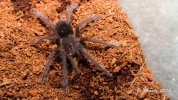
  • IMG_9733a New antinous girl Wtrmk sm.jpg
    IMG_9733a New antinous girl Wtrmk sm.jpg
    409 KB · Views: 100
Last edited:

MassExodus

Well-Known Member
1,000+ Post Club
3 Year Member
Messages
5,547
Location
Outside San Antonio, TX
I'm interested in any responses to your question..I lost a 5-6" female antinous to a bad molt a few days ago. I kept her moist , well ventilated and well fed..definitely the worst loss I've ever had in my collection. She was gorgeous. Can't help wondering if it was my fault. Anyway congratulations on the new T :)
 

Tomoran

Well-Known Member
3 Year Member
Tarantula Club Member
Messages
800
Location
Connecticut
I'm interested in any responses to your question..I lost a 5-6" female antinous to a bad molt a few days ago. I kept her moist , well ventilated and well fed..definitely the worst loss I've ever had in my collection. She was gorgeous. Can't help wondering if it was my fault. Anyway congratulations on the new T :)

Oh no...that's terrible. Man, I'm so sorry to hear about that. Personally, it sounds to me like you were keeping her perfectly fine, so I truly doubt it was your husbandry. :(
 

Tomoran

Well-Known Member
3 Year Member
Tarantula Club Member
Messages
800
Location
Connecticut
Hi all. Though I have been a member here for some time (don't remember when I joined), I haven't posted much.

I had an amazing call from a friend I know online yesterday (we had been trying to arrange a phone call for a couple months). Instead of talking like I expected, he told me I needed to go immediately to the post office to pick up a package. I drove a couple blocks down to pick up a package from Tarantula Canada and came home to open it and find he had bought me their female P. antinous (2")! They had listed it for the last week or two at best, but I first saw it earlier this week.

This was HUGE as I had lost a huge 8" female two years ago that died when my space heater malfunctioned over a weekend I was gone. Came home to find the room at 108*F. I lost a couple others, but this 8" girl really hurt. I had her about a year and she had just turned dark for the first molt in my care.

Anyway, I have no doubt I can raise this sling (not new to the hobby), but am interested to know what tips others here have for care for an antinous. Perhaps there are details and perspective I could learn from here.

And a little background about me. I currently have 48 Ts and a breeder on loan (G. pulchripes). Some 27 species at the moment, all New World save for one M. balfouri sling. I love NW spiders. Between two collections in my life, I have about 10 years experience with tarantulas. I have successfully bred G. rosea (RCF), and B. smithi, and am currently waiting with fingers crossed for a few other girls to drop sacs (G. rosea RCF again with the same father who is 4 or 5 years mature now), B. emilia, B. albiceps, and G. pulchripes. I also love doing tarantula presentations at schools and libraries and have done at least 6 this year.

And here is a picture of this girl I got yesterday.


Congrats on your your new girl! :)

I keep mine on fairly deep moist substrate with a hide, and she's always been a bit of a shy girl. Right up until she was about 5-6" or so, she literally lived like a fossorial species, only coming out of her den at night. Personally, I like giving the moisture-dependent species deeper sub, as it's easier to keep the bottom layers of it moist so they can dig to what moisture levels they need. I let the top dry out and add water when I notice the moist levels on the bottom starting to shrink. In the summer time, I rarely moisten it at all as the humidity here is usually quite high and it becomes overkill.

She's probably pushing around 7.5" or so now (I still haven't been able to get an accurate measurement on her) and she's dug a shallow burrow beneath some cork bark and she's usually hiding beneath it. She's got a large water dish, and I've been re-moistening the sub every few weeks or so now that the heat has kicked on. For temps, she's at 75-80 during the warm months and 70-75 during the cold months.

Here's a video with my gal who FINALLY came out to say hi. :)


ManlyMan7

Member
3 Year Member
Messages
49
Thanks Tomoran. That is helpful.

I know they are wetter, cooler Ts than most, though I have read they are not swamp-spiders (like Theraphosas).

I like your setup to provide deeper substrate and keeping it moist. My girl I received as an 8" girl about a year before she died did not burrow much. I had a big homemade coconut hide for her (it took a very large coconut to fit her), and enough she could burrow down in, but not enough to really tunnel. She didn't even try though.

I can't help wonder if she did have the substrate and did make a burrow, she would have survived he incident.

I have also read that they are prone to over-eating. While most Ts will simply stop eating once they get full enough, not the P. antinous. Care should especially be made to not over-feed if they are gravid. And my big girl certainly had an antinous appetite.

I gotta say that yours looks stockier than my girl did, reminiscent of what I have seen of P. sp. chicken spider. But I am basing that on one video. Still, a very nice looking girl you have there.

Finally, here is a couple pictures
IMG_7091 Wtrmk sm.jpg
IMG_7096 Wtrmk sm.jpg
of my big girl...
 

Redacted

Well-Known Member
3 Year Member
Messages
519
Thanks Tomoran. That is helpful.

I know they are wetter, cooler Ts than most, though I have read they are not swamp-spiders (like Theraphosas).

I like your setup to provide deeper substrate and keeping it moist. My girl I received as an 8" girl about a year before she died did not burrow much. I had a big homemade coconut hide for her (it took a very large coconut to fit her), and enough she could burrow down in, but not enough to really tunnel. She didn't even try though.

I can't help wonder if she did have the substrate and did make a burrow, she would have survived he incident.

I have also read that they are prone to over-eating. While most Ts will simply stop eating once they get full enough, not the P. antinous. Care should especially be made to not over-feed if they are gravid. And my big girl certainly had an antinous appetite.

I gotta say that yours looks stockier than my girl did, reminiscent of what I have seen of P. sp. chicken spider. But I am basing that on one video. Still, a very nice looking girl you have there.

Finally, here is a couple picturesView attachment 20541 View attachment 20542 of my big girl...
What a beautiful T. I hope that you continue with the the genus.
 

ManlyMan7

Member
3 Year Member
Messages
49
Thanks Walter. She was amazing! I was sold her as a 6" female, but she was every bit of an 8" girl.

And what I am seeing today for pricing, I got her at a steal.

Let's just say I bought her for less than this person paid for the 2" female two days ago!
 

Redacted

Well-Known Member
3 Year Member
Messages
519
Thanks Walter. She was amazing! I was sold her as a 6" female, but she was every bit of an 8" girl.

And what I am seeing today for pricing, I got her at a steal.

Let's just say I bought her for less than this person paid for the 2" female two days ago!
 

Redacted

Well-Known Member
3 Year Member
Messages
519
I am waiting on your comment that you seem to have left out.

:D

Sent from my SGH-I337M using Tapatalk
I'm a caveman with technology. Ha!

Meant to say nice going on the price. That could mean that you have funds forcanother T.
 

ManlyMan7

Member
3 Year Member
Messages
49
I'm a caveman with technology. Ha!

Meant to say nice going on the price. That could mean that you have funds for another T.

Well, that was 3 years ago. But it is awesome someone gifted me with this little girl last week. I have been looking around for awhile, and ever seeing what was out there (not much), but not in a position to afford or justify something like this.

Now I have the fun of raising her! :D

I hear they can really grow in molts. Someone in a thread elsewhere said theirs molted from 3" to 5" in one molt!
 

ManlyMan7

Member
3 Year Member
Messages
49
Just keep them like Theraphosa. You can keep all the Pamphobeteus successfully that way.

Ok, thanks for piping in, but this I am hearing conflicting reports here. I have had a few tell me in the last few days that they are hardy and can be kept "normally" save with higher humidity. I have read somewhere that they are not quite swamp monsters like the Theraphosas. I have also read that these are prone to over eating if fed enough.

I want to keep this little one optimally and am hopeful of getting the right information.
 

micheldied

Well-Known Member
3 Year Member
Messages
396
Ok, thanks for piping in, but this I am hearing conflicting reports here. I have had a few tell me in the last few days that they are hardy and can be kept "normally" save with higher humidity. I have read somewhere that they are not quite swamp monsters like the Theraphosas. I have also read that these are prone to over eating if fed enough.

I want to keep this little one optimally and am hopeful of getting the right information.

They are definitely hardier than the Theraphosa in captivity, but they're found in nearly the same environments as Theraphosa in the wild (humid and damp).
 

Tomoran

Well-Known Member
3 Year Member
Tarantula Club Member
Messages
800
Location
Connecticut
Thanks Tomoran. That is helpful.

I know they are wetter, cooler Ts than most, though I have read they are not swamp-spiders (like Theraphosas).

I like your setup to provide deeper substrate and keeping it moist. My girl I received as an 8" girl about a year before she died did not burrow much. I had a big homemade coconut hide for her (it took a very large coconut to fit her), and enough she could burrow down in, but not enough to really tunnel. She didn't even try though.

I can't help wonder if she did have the substrate and did make a burrow, she would have survived he incident.

I have also read that they are prone to over-eating. While most Ts will simply stop eating once they get full enough, not the P. antinous. Care should especially be made to not over-feed if they are gravid. And my big girl certainly had an antinous appetite.

I gotta say that yours looks stockier than my girl did, reminiscent of what I have seen of P. sp. chicken spider. But I am basing that on one video. Still, a very nice looking girl you have there.

Finally, here is a couple picturesView attachment 20541 View attachment 20542 of my big girl...

My lord, what a beautiful animal. WOW. And so docile. What a gorgeous tarantula.

As for the moisture levels, I did not worry about it as much with my pamphos as I did with my Therophosas. They've all got large water dishes, and I would let the top layers of the substrate dry out a bit in between "making it rain". That kept things from getting too stuffy. Again, it's usually VERY humid here during the summer months, so I often wouldn't worry at all about moistening it then. In the winter the furnace dries out the air, so I'm a bit more careful. I think it's always important to consider your local humidity levels when worrying about moisture. If it's already 90% humidity and you're soaking down your substrate, it can be overkill.

I haven't witnessed any of the over eating myself; my P. antinous and Pampho sp. durans all stopped eating once they entered premot. They DO get quite plump before they stop, so perhaps that's where folks are having issues.

Mine is a bit more slender than she appears in the video; I think it was because she was hunched up while eating those roaches. :)
 

ManlyMan7

Member
3 Year Member
Messages
49
My lord, what a beautiful animal. WOW. And so docile. What a gorgeous tarantula.

As for the moisture levels, I did not worry about it as much with my pamphos as I did with my Therophosas. They've all got large water dishes, and I would let the top layers of the substrate dry out a bit in between "making it rain". That kept things from getting too stuffy. Again, it's usually VERY humid here during the summer months, so I often wouldn't worry at all about moistening it then. In the winter the furnace dries out the air, so I'm a bit more careful. I think it's always important to consider your local humidity levels when worrying about moisture. If it's already 90% humidity and you're soaking down your substrate, it can be overkill.

I haven't witnessed any of the over eating myself; my P. antinous and Pampho sp. durans all stopped eating once they entered premot. They DO get quite plump before they stop, so perhaps that's where folks are having issues.

Mine is a bit more slender than she appears in the video; I think it was because she was hunched up while eating those roaches. :)

Thanks. She was awesome. She would normally either freeze or flee in hand. She would get runny at times, and that was scary as she would run off the end of my hand and hang onto my hand with her last tarsal hooks, the swing under with all 55g of her. But she was not testy or even all that flicky. I would only get her out on the floor of my home office with its padded carpet and keep it all low to the ground. But I was determined to calm her down, and I did.
I have seen vids online of much calmer antinous girls, so I am hopeful for this little one.

Thanks for the care details. I think I did quite well with this big girl ((Zipporah), but as I did not raise her from a sling, and I only had her about a year before the space heater malfunctioned. I have seen differing care recommendations for them online, so I thought I would seek more info.

And I have read that they can eat themselves to death, so that is why I brought it up. And my copy of Cleton, Sigwalt and Verdez's Tarantulas: Breedin Experience and Wildlife does caution not to overfeed gravid females (would LOVE to have the opportunity to breed them some day). Someone elsewhere claims they can't be overfed.
 

CrypticSpider

Well-Known Member
3 Year Member
Messages
291
Location
Where the Spiders are.
Deep, packed substrate. An appropriately-sized hide. (they love cork rounds) Waterdish. Add fake foilage as desired for pleasing aesthetic viewing. Keep lower layer of substrate damp. Relax. Enjoy your beautiful spider. :)

As for the weight/over-eating.

They get overweight quicky and easily. Curb the urge to feed them too much, even tho they are fantastic eaters.
 

Redacted

Well-Known Member
3 Year Member
Messages
519
Deep, packed substrate. An appropriately-sized hide. (they love cork rounds) Waterdish. Add fake foilage as desired for pleasing aesthetic viewing. Keep lower layer of substrate damp. Relax. Enjoy your beautiful spider. :)

As for the weight/over-eating.

They get overweight quicky and easily. Curb the urge to feed them too much, even tho they are fantastic eaters.
Generally speaking, a lot of food makes for fast growth as a youngster and dangerous obesity for an adult. True for lizards, snakes, and Ts at least. Although even with toungsters that need to grow, easy to overdo it.
 

MassExodus

Well-Known Member
1,000+ Post Club
3 Year Member
Messages
5,547
Location
Outside San Antonio, TX
I've never encountered any problems from overfeeding..but I'm beginning to suspect I may have killed my antinous. she was quite fat when she died in her molt. An expensive and careless mistake on my part, I believe. I should have listened to the overfeeding comments. Arrogance will be my downfall.
 

Latest posts

Top